
Get to know Ladderax
The Complete Guide to Ladderax
From Robert Heal’s 1960s modular shelving system for Staples to today’s collector market, Ladderax remains one of the most flexible and recognisable pieces of British mid-century design.
A shelving system that can be rebuilt for life.
Ladderax is not just a shelving unit. It is a modular furniture system made from upright “ladders”, support rods, shelves and interchangeable cabinets. The system allows a room to be changed without replacing the furniture: cabinets can move, shelves can be repositioned, bays can be added and whole layouts can be reworked.
That adaptability is the reason Ladderax still feels modern. A set can be used as a bookcase, drinks cabinet, record storage system, display wall, bureau, home office or complete living room installation. Few mid-century systems offer the same level of design flexibility.
The Ladderax pieces we handle at Hus & Home often include teak shelving, glazed cabinets, sliding-door cabinets, record cabinets, bureau units, drawers and black, white, gold, teak or rosewood uprights.

The history of Staples Ladderax
Ladderax was designed by Robert Heal and introduced by Staples of Cricklewood, London, during the 1960s. It brought together British practicality, Scandinavian-influenced simplicity and a clever modular engineering idea that made it unlike most traditional cabinet furniture.
Staples grew from the British bedding and furniture industry, later becoming best remembered by collectors for its Ladderax storage system.
Ladderax was introduced as a modular storage system by Robert Heal for Staples, using ladders, rods, shelves and cabinets.
The system became a desirable modern furnishing choice for homes wanting adaptable storage, display and workspace furniture.
Original Ladderax systems are sought after for their engineering, modularity, materials and practical use in modern interiors.
How Ladderax works
The genius of Ladderax is that it goes together without the usual cabinet screws, fixed frames or permanent wall mounting. The shelves and cabinets sit on metal support rods, which hook into the rungs of the upright ladders.
This means the arrangement can be changed. A bureau can move from one bay to another, a glazed cabinet can be raised or lowered, shelves can be spaced differently, and additional bays can be added when more storage is needed.

Multi-bay Ladderax wall systems
One of the most impressive Ladderax configurations is the full wall system. These can be built as two, three, four or even larger bay arrangements, depending on the number of ladders, rods, shelves and cabinets available.
Large systems can combine glazed display cabinets, drawer units, wooden-front cabinets, open shelves and record storage, creating a complete wall of storage that can still be adjusted as needs change.
- Two and three bay systems are ideal for living rooms, dining rooms and offices.
- Larger runs can act as a complete room-defining feature wall.
- Cabinets and shelves can be repositioned rather than permanently fixed.
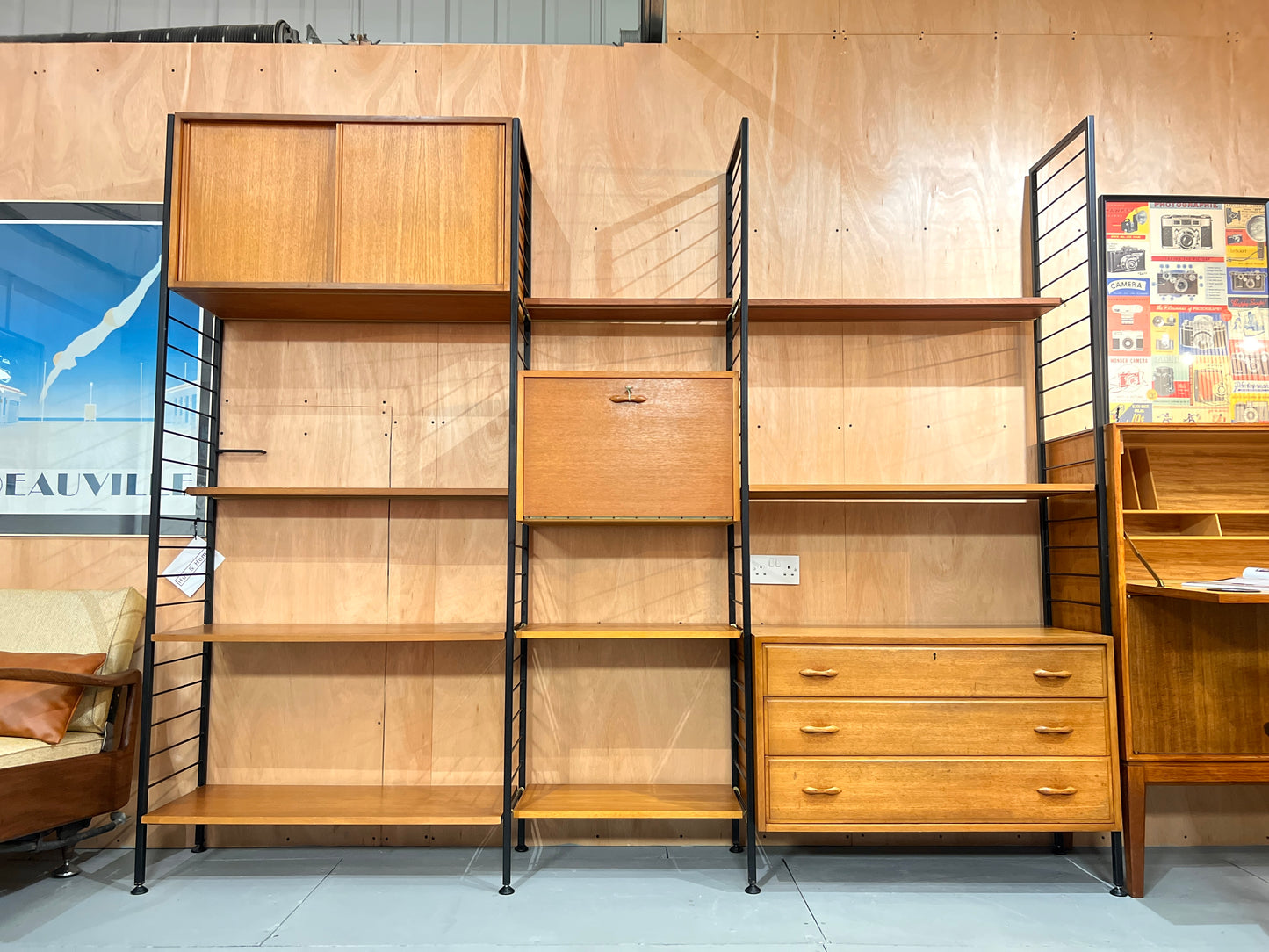
Uprights: black, white, gold, teak and rosewood
The uprights are the backbone of Ladderax. Many systems use slim metal ladders, commonly seen in black, white or gold finishes. These give the furniture its light architectural outline and allow shelves and cabinets to sit at different heights.
Wooden uprights were also produced, including teak and rosewood examples. Rosewood Ladderax is less commonly encountered and tends to appeal strongly to collectors because of its richer colour and grain.
- Metal uprights can be black, white or gold/brass-toned.
- Teak uprights create a warmer, more furniture-led look.
- Rosewood uprights are scarcer and often more collectable.
- Different heights and depths allow compact or full-height installations.
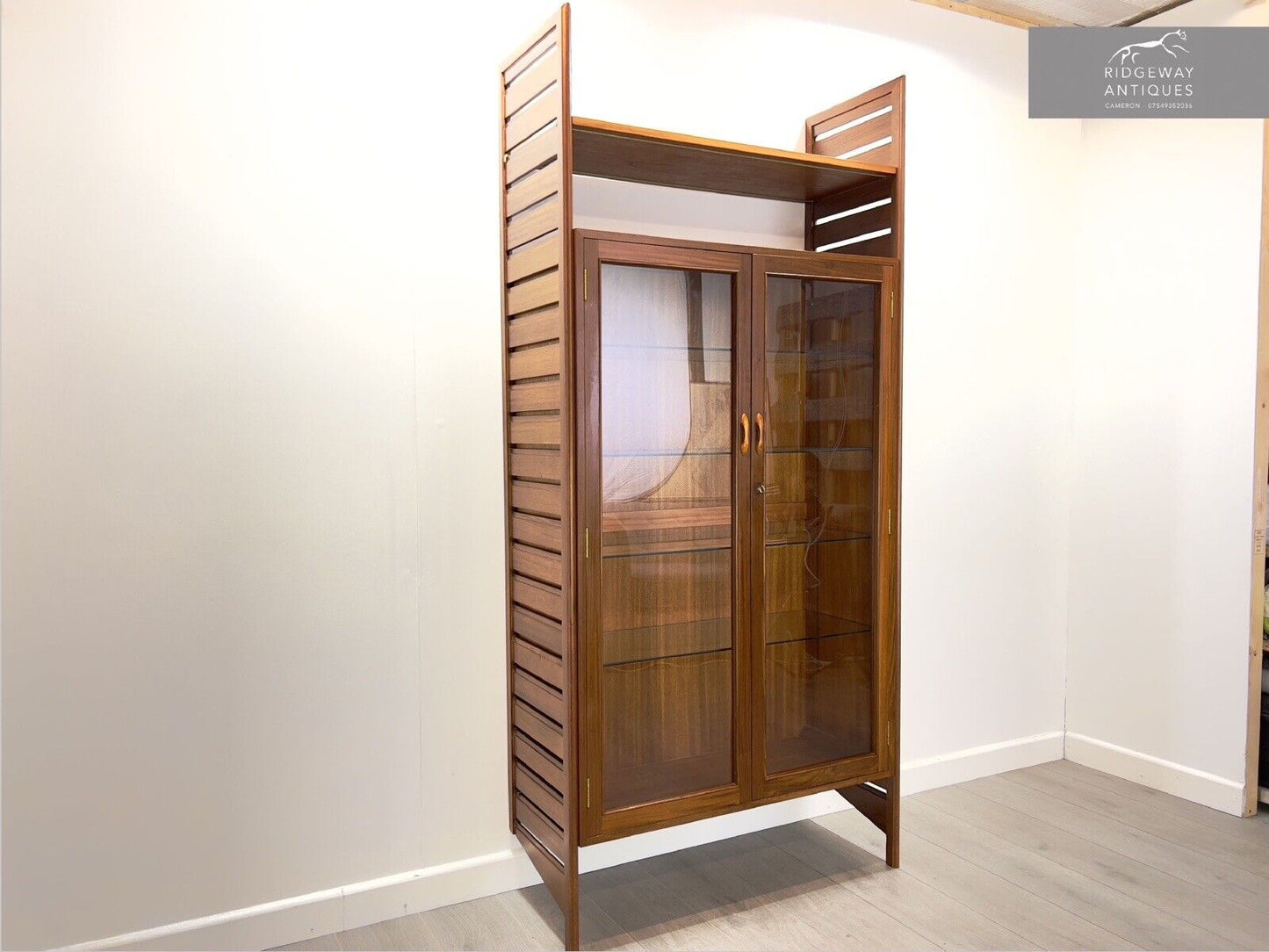
Glazed cabinets and display units
Glazed cabinets are among the most useful Ladderax components. They allow books, ceramics, glassware, records, collectables and decorative pieces to be displayed while still feeling integrated within a wider shelving system.
Some glazed cabinets are narrow, some are wider, and some include internal glass shelves. They can be positioned high for display, lower for easier access, or combined with shelves and storage cabinets to balance open and concealed storage.
- Glass-fronted cabinets for ceramics, books and display pieces.
- Open shelving for magazines, artwork and everyday objects.
- Cabinet heights can be changed using the ladder rungs and support rods.

Bureaus, desks and workspaces
Ladderax was not limited to display shelving. Bureau and desk units turned the system into a compact working area, making it particularly useful for flats, studies, living rooms and multi-purpose spaces.
Drop-front bureau cabinets can provide a writing surface with storage inside, while single drawer units can also act as small desks or dressing-table style surfaces. It is this blend of storage and workspace that makes Ladderax so adaptable today.
- Drop-front bureau cabinets with internal compartments.
- Single drawer units that can work as a desk surface.
- Good for home offices where full-size desks are too large.

Rosewood Ladderax
Rosewood Ladderax is less common than teak examples and has a very different presence. The darker tone and stronger grain pattern give it a more luxurious look, particularly when paired with glass-fronted cabinets or record storage.
Single bay rosewood systems can still make a strong impact, especially when used as a display unit, music storage area or compact statement piece.
- Less commonly seen than teak Ladderax.
- Often desirable to collectors because of the richer grain.
- Works well in music rooms, offices and darker interior schemes.
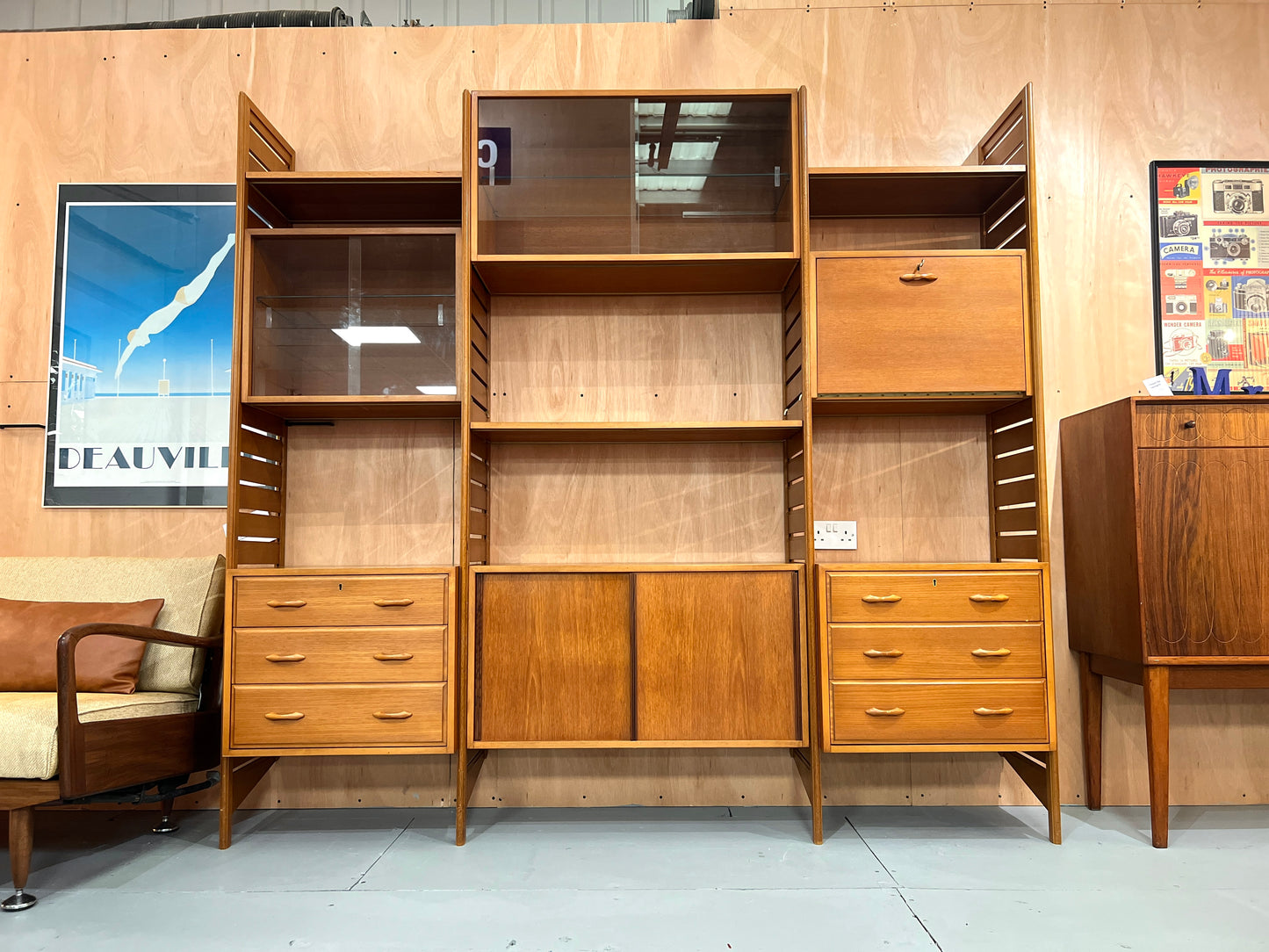
Drinks cabinets, drawers and record storage
Part of the appeal of Ladderax is the variety of cabinet types. A single system might include a drinks cabinet, a chest of drawers, a record cabinet, sliding wooden doors, a glazed display unit and open shelves.
Collectors often look for complete systems with a strong mix of useful components. Record cabinets and bureau units are particularly popular today because they suit modern listening rooms, living rooms and home office spaces.
- Drinks cabinets and drop-front cabinets for concealed storage.
- Drawers for paperwork, smaller objects and household storage.
- Record cabinets and LP display shelves for vinyl collections.
Materials that define the look
Ladderax combines slim structural lines with warm cabinet materials. This mixture of engineered metalwork and natural veneers is what gives the system its distinctive mid-century character.
Teak
Teak is the timber most strongly associated with Ladderax systems. It provides warmth, durability and a rich mid-century appearance, especially on shelves, bureau fronts and cabinet doors.
Rosewood
Rosewood examples are less commonly found and are often more visually dramatic. The darker grain makes these systems especially desirable when complete and in good original condition.
Steel
Steel uprights and support rods give Ladderax its engineering strength. Black, white and gold/brass-toned finishes all change the visual feel of the system while keeping the same modular principle.
Design relatives and influences
Ladderax belongs to a wider mid-century movement towards modular, flexible storage. It shares some design thinking with Danish wall systems such as Poul Cadovius’ Royal System, as well as other modular furniture lines including Interflex, Robex and Avalon.
IKEA also produced rare modular wall systems during the 1960s, although they are seen in far lower numbers today. Ladderax remains distinct because it combines British practicality with a highly adaptable freestanding structure.
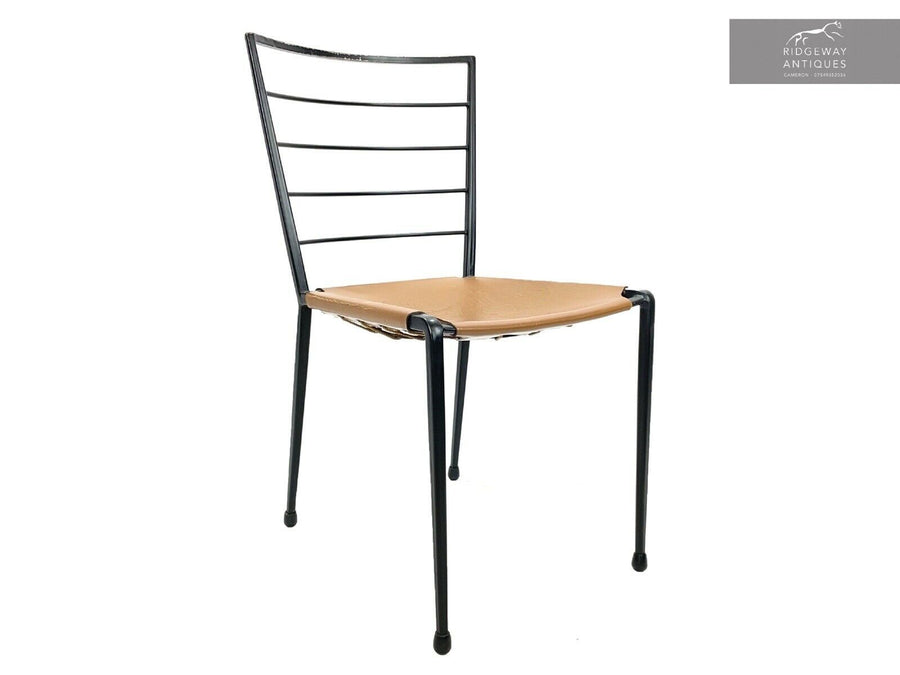
The rarely seen Ladderax chair
Although Ladderax is best known for shelving and storage, Staples also produced other pieces of furniture. The Ladderax steel and leather chair is far less commonly seen than the wall systems, but it shows that the design language extended beyond cabinets and shelves.
The chair has the same light, linear quality as the shelving system, using slim steelwork and a straightforward modern profile. It is a useful reminder that Ladderax was part of a broader design idea, not simply a bookcase.
Why collectors still love Ladderax
Ladderax succeeds because it is both beautiful and genuinely useful. It can be rebuilt, expanded, reduced, moved and reconfigured. It can be a bookcase one year, a record wall the next, and a home office after that.
That combination of practical engineering, mid-century materials and visual flexibility is why Staples Ladderax remains one of the great British modular furniture systems.
References and further reading
This guide has been written for Hus & Home using our own stock experience, product archive and customer photography, with a small number of external references for historical context.
The Wonder of Staples Ladderax • Staples & Co history • Current Ladderax at Hus & Home